NPS calculator · India 2026
NPS Calculator India 2026: Estimate Corpus, 80% Lumpsum & Monthly Pension
By Pratik Bajoria, Chartered Accountant & NISM-certified Research Analyst · Updated 3 October 2026
The National Pension System (NPS) is a low-cost, market-linked retirement scheme regulated by the Pension Fund Regulatory and Development Authority (PFRDA). This NPS calculator estimates your corpus at 60 from a monthly contribution, an assumed return and years left, then splits it into lumpsum and annuity so you can estimate your monthly pension.
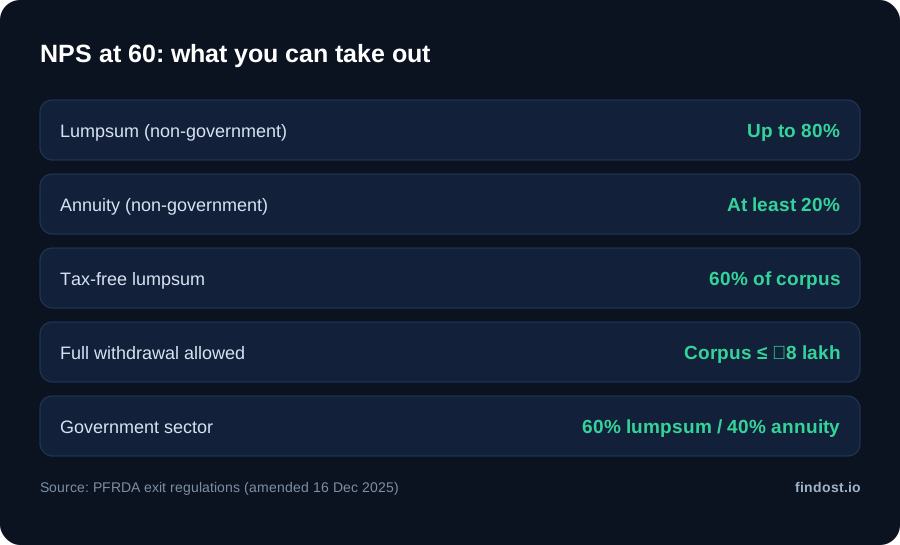
It reflects the amended PFRDA exit rules notified in December 2025: non-government subscribers can now take up to 80% as lumpsum with a minimum 20% annuity (previously 60:40). Government-sector subscribers should set the annuity slider to at least 40%.
Estimated NPS corpus at retirement
₹1.34 Cr
This calculator projects the corpus and pension. To see how much of an 80% lumpsum is actually taxed, use the NPS withdrawal tax calculator.
NPS withdrawal rules 2026 at a glance
Summary of normal exit (at 60 / superannuation / 15 years in NPS) for non-government subscribers under the amended PFRDA (Exits and Withdrawals under NPS) Regulations. For pension and tax worked in ₹, read the NPS 80:20 rule pension impact explainer:
| Accumulated corpus | Options (non-government) |
|---|---|
| Up to ₹8 lakh | 100% lumpsum (or systematic withdrawal), or up to 80% lumpsum + at least 20% annuity |
| ₹8 lakh – ₹12 lakh | Up to ₹6 lakh lumpsum with the balance via systematic unit redemption (min. 6 years) or annuity, or up to 80% lumpsum + at least 20% annuity |
| Above ₹12 lakh | Up to 80% lumpsum; at least 20% annuity |
| Premature exit | Up to 20% lumpsum; at least 80% annuity (unchanged). If the corpus is ₹5 lakh or less, 100% can be withdrawn |
| Government sector | Up to 60% lumpsum; at least 40% annuity |
Source: PIB release on PFRDA amendments (19 December 2025). The amendments also raised the NPS entry and exit age to 85, removed the 15-day prior intimation to continue beyond 60, and let All Citizen subscribers exit normally after 15 years in NPS or at 60, whichever is earlier. Rules change — verify with PFRDA, NPS Trust or your CRA before exiting.
NPS calculator formula
Corpus = P × [((1 + i)n − 1) ÷ i] × (1 + i) · Pension ≈ Corpus × annuity% × annuity rate ÷ 12
P = monthly contribution, i = assumed annual return ÷ 12, n = months to retirement. Example: ₹10,000 a month, 10%, 25 years → corpus ≈ ₹1,33,78,903 on ₹30,00,000 contributed. With the 80:20 split: lumpsum up to ₹1,07,03,123, annuity corpus ₹26,75,781, and at an assumed 6% annuity rate a pension of about ₹13,379/month.
NPS pension calculator table: ₹5,000, ₹10,000, ₹20,000 per month
25 years of contributions (e.g. age 35 → 60) at an assumed 10% return. Pension uses an illustrative 6% annuity rate — not a quote from any Annuity Service Provider.
| Monthly | Contributed | Corpus at 60 | 80% lumpsum | Pension (20% annuity) | Pension (40% annuity) |
|---|---|---|---|---|---|
| ₹5,000 | ₹15,00,000 | ₹66,89,452 | ₹53,51,561 | ₹6,689/mo | ₹13,379/mo |
| ₹10,000 | ₹30,00,000 | ₹1,33,78,903 | ₹1,07,03,123 | ₹13,379/mo | ₹26,758/mo |
| ₹20,000 | ₹60,00,000 | ₹2,67,57,807 | ₹2,14,06,246 | ₹26,758/mo | ₹53,516/mo |
A smaller annuity slice means a larger lumpsum but a smaller guaranteed pension — the lumpsum then has to be invested and drawn down carefully (see the SWP calculator). Annuity income is taxable at slab rates.
Chart: ₹10,000/month NPS corpus at 8%, 10% and 12%
NPS return assumption: how sensitive is the corpus?
₹10,000 a month for 25 years (₹30 lakh contributed):
| Assumed return | Corpus at 60 | Pension from 20% annuity |
|---|---|---|
| 8% | ₹95,73,666 | ₹9,574/mo |
| 9% | ₹1,12,95,304 | ₹11,295/mo |
| 10% | ₹1,33,78,903 | ₹13,379/mo |
| 11% | ₹1,59,05,812 | ₹15,906/mo |
| 12% | ₹1,89,76,351 | ₹18,976/mo |
Start NPS at 25, 30, 35, 40 or 45?
₹10,000 a month until 60 at an assumed 10%:
| Start age | Contributed | Corpus at 60 |
|---|---|---|
| 25 | ₹42,00,000 | ₹3,82,82,767 |
| 30 | ₹36,00,000 | ₹2,27,93,253 |
| 35 | ₹30,00,000 | ₹1,33,78,903 |
| 40 | ₹24,00,000 | ₹76,56,969 |
| 45 | ₹18,00,000 | ₹41,79,243 |
NPS tax benefits: old vs new tax regime
| Deduction | Old regime | New regime |
|---|---|---|
| 80CCD(1) — own contribution | Yes, within ₹1.5 lakh 80C/80CCC limit | No |
| 80CCD(1B) — extra own contribution | Yes, up to ₹50,000 | No |
| 80CCD(2) — employer contribution | Up to 10% of basic + DA (14% for government employers) | Up to 14% of basic + DA |
Employer contributions to NPS, EPF and superannuation above ₹7.5 lakh a year in aggregate are taxable. Section numbers are from the Income-tax Act, 1961 as commonly cited; verify the corresponding provisions and limits for your tax year on the Income Tax portal. Choosing a regime? Try the old vs new tax calculator.
NPS vs PPF vs mutual fund SIP for retirement
| Feature | NPS | PPF | Mutual fund SIP |
|---|---|---|---|
| Returns | Market-linked | Government-notified rate, reset quarterly | Market-linked |
| Lock-in | Till 60 (limited partial withdrawals) | 15 years (partial withdrawal rules) | None (ELSS: 3 years) |
| At maturity | Mandatory annuity slice (min 20% non-govt) | Full withdrawal | Redeem or SWP anytime |
| Plan with | This page | PPF calculator | SIP calculator |
NPS lets you choose between Active Choice (you set the equity/corporate debt/government securities mix, with equity capped as per PFRDA norms) and Auto Choice (life-cycle funds that reduce equity as you age). For the overall number you need at retirement, start with the retirement calculator and the retirement planning guide, and keep a separate emergency fund — NPS money is not accessible for emergencies.
For salaried employees, NPS is usually one of several retirement pots. Project your provident fund with the EPF calculator and your employer payout with the gratuity calculator before deciding how much extra to put into NPS. Comparing guaranteed and market-linked options for other goals? See SIP vs FD vs PPF.
People also ask: NPS calculator FAQs
How does the NPS calculator work?
It compounds your monthly NPS contribution at an assumed annual return until retirement using the future value of a monthly annuity, then splits the corpus into a lumpsum portion and an annuity portion based on the annuity percentage you choose. For example, ₹10,000 a month for 25 years at an assumed 10% gives about ₹1.34 crore on ₹30 lakh contributed.
How much lumpsum can I withdraw from NPS at 60 in 2026?
Under PFRDA's amended Exit and Withdrawal Regulations (notified December 2025), non-government subscribers (All Citizen and Corporate models) can take up to 80% of the corpus as lumpsum and must buy an annuity with at least 20% at normal exit. If the corpus is ₹8 lakh or less, 100% can be withdrawn. Government-sector subscribers continue with up to 60% lumpsum and at least 40% annuity. Always confirm the current rules with PFRDA or your CRA.
How much pension will I get from NPS?
Your pension depends on the annuity corpus and the annuity rate you are offered at retirement. Illustration only: ₹10,000 a month for 25 years at 10% builds about ₹1.34 crore; 20% of that (₹26.8 lakh) at an assumed 6% annuity rate pays roughly ₹13,400 a month before tax. Annuity rates vary by provider, option and age, and annuity income is taxable.
What return should I assume for NPS?
NPS returns are market-linked and not guaranteed. They depend on your equity/corporate bond/government securities mix and fund manager. Run the calculator at several rates (for example 8%, 10% and 12%) and check historical scheme returns published by NPS Trust rather than relying on one number.
What are the NPS tax benefits in the new tax regime?
Under the new regime only the employer's contribution is deductible (Section 80CCD(2), up to 14% of basic + DA). Under the old regime you can also claim your own contribution under 80CCD(1) within the ₹1.5 lakh 80C limit and an extra ₹50,000 under 80CCD(1B); private-sector employer contributions are capped at 10% of basic + DA in the old regime. Section numbers refer to the Income-tax Act, 1961; confirm the corresponding provisions for your tax year.
Is NPS better than PPF or a mutual fund SIP?
They do different jobs. PPF offers a government-set, currently tax-free return with a 15-year lock-in; NPS is market-linked, low-cost and locked until retirement with a mandatory annuity slice; mutual fund SIPs are flexible but have no lock-in discipline or retirement-specific tax benefit. Many households combine them — compare with the PPF and SIP calculators.
Can I exit NPS before 60?
Yes. Under the December 2025 amendments, All Citizen subscribers reach normal exit after 15 years in NPS or at age 60, whichever is earlier, and the 5-year lock-in for premature exit was removed. On premature exit, non-government subscribers can take at most 20% as lumpsum and must annuitise at least 80% (100% withdrawal is allowed if the corpus is ₹5 lakh or less). Partial withdrawals are allowed up to 4 times before 60, with a 4-year gap between withdrawals.
Why can I set the annuity slider below 20%?
Because subscribers whose accumulated corpus is ₹8 lakh or less may withdraw 100% as lumpsum under the amended rules. For larger corpora, non-government subscribers should keep at least 20% and government subscribers at least 40% in the annuity portion.
Educational tool only — not investment, pension or tax advice. NPS returns are market-linked and not guaranteed; annuity rates shown are assumptions, not quotes. Verify contribution limits, exit rules and tax treatment with PFRDA / NPS Trust and the Income Tax Department. Findost (findost.io) and PaisaGuru by Findost are not affiliated with Findoc or FinDost.
Explore more: all calculators, SIP calculator, SWP calculator, PPF calculator, EPF calculator, gratuity calculator, NPS 80:20 rule guide, retirement calculator, direct vs regular mutual funds, direct vs regular calculator, fund overlap calculator, emergency fund guide, XIRR vs CAGR and how many mutual funds to hold.
Where to go next
Under the December 2025 exit rules you can take up to 80% as a lumpsum. Before you do, read theNPS 80:20 rule guide: the extra 20% may be taxed and your pension roughly halves. Add your employer payout from the gratuity calculator to see the full retirement picture.