2026-09-01
Mutual Fund Riskometer: 6 Levels Before a SIP
A SIP sets when money goes in. The scheme’s Riskometer discloses how risky that money becomes once invested. Confusing the two is one of the most common beginner mistakes in India: a small monthly amount feels safe even when the fund sits at High or Very High risk.
Direct answer
Before you start or increase a SIP, read the scheme’s current Riskometer, investment objective, and portfolio disclosures. Match them to the goal’s time horizon and whether you could hold through a fall without being forced to sell. A SIP does not lower the Riskometer.
What the SEBI Riskometer is (and is not)
SEBI requires every mutual fund scheme to show a Riskometer — a six-level visual risk disclosure: Low, Low to Moderate, Moderate, Moderately High, High, Very High.
It is not a forecast of next year’s return, a star rating, or a personal suitability certificate. It compresses factors such as asset type, market volatility, credit risk and interest-rate sensitivity into one label. Two funds with similar recent returns can still carry different risk labels.
Primary source: SEBI Investor — Understanding the Riskometer
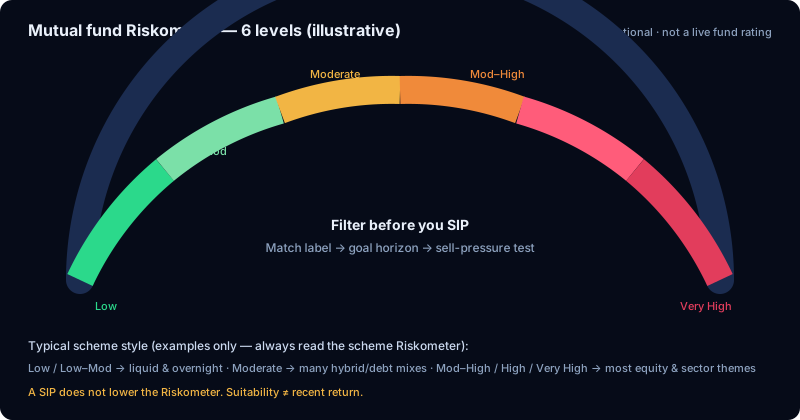
Figure: illustrative Riskometer bands for education. Always use the label printed on the specific scheme’s factsheet / SID — labels can change when portfolios change.
Riskometer levels vs what they usually mean
Use this as a reading aid, not a product shortlist. Exact category mapping varies by scheme; confirm on AMC / registrar disclosures.
| Riskometer level | What it signals (plain language) | Typical scheme styles (examples only) | SIP / horizon thinking |
|---|---|---|---|
| Low | Lower expected NAV swings; still not “guaranteed” | Overnight, many liquid funds | Short parking / emergency buffer — still read liquidity & credit notes |
| Low to Moderate | Mild risk step-up | Ultra-short / some short-duration debt | Near-term goals if you accept small mark-to-market moves |
| Moderate | Meaningful ups and downs possible | Many hybrid / conservative allocation mixes; some debt categories | Medium goals only if you can stay invested through dips |
| Moderately High | Larger drawdowns possible | Aggressive hybrid, some equity-oriented mixes | Prefer multi-year goals; avoid money you may need soon |
| High | Equity-like volatility common | Broad equity categories | Long horizons; stress-test “would I sell if NAV is −20%?” |
| Very High | Highest disclosed band | Many sector, thematic, small/mid-cap style schemes | Longest horizons + high sell-pressure tolerance — not “more SIP = safer” |
Governing disclosure framework: SEBI Master Circular for Mutual Funds (20 March 2026).
The SIP myth: “small SIP = low risk”
| Habit people assume is “safe” | What actually drives risk |
|---|---|
| “Only ₹2,000 / month SIP” | Scheme Riskometer + underlying assets |
| “I’ve been SIPping for 6 months” | Holding period vs goal date & liquidity need |
| “It beat the market last year” | Past return ≠ future risk label |
| “Direct plan is safer” | Direct vs Regular is mainly cost/service — see Direct vs Regular |
For a goal that may need cash soon, the right question is not “Can I afford the SIP?” It is “Can this money stay invested if NAV is down when I need it?”
A practical pre-SIP filter
- Name the goal and the date you might need the money.
- Separate an emergency reserve so a market fall does not force a redemption.
- Read Riskometer + objective + top holdings (factsheet / SID), not only 1-year returns.
- Compare with the benchmark Riskometer for context — still not a prediction.
- Re-check after portfolio changes — labels can move when risk characteristics change.
- Run the sell-pressure test: if value falls, would you have to sell before the goal date?
If step 6 is “yes”, pause and revisit goal, horizon and liquidity — do not “fix” the mismatch with a larger SIP.
Worked example (illustrative behaviour, not advice)
| Goal | Horizon | Scheme Riskometer (example) | Educational takeaway |
|---|---|---|---|
| House down-payment buffer | 10–14 months | High / Very High equity scheme | High chance you need cash in a down market — mismatch risk |
| Child education corpus | 12+ years | High equity (diversified) | Volatility may be tolerable if you will not redeem mid-fall |
| 3-month expense reserve | Immediate | Low / Low to Moderate liquid-style | Riskometer should match near-term access needs |
These rows are teaching scenarios. They are not recommendations of named funds or TERs.
FAQ
Does starting a SIP reduce mutual fund risk?
No. SIP only staggers purchases. Risk remains whatever the scheme discloses on its Riskometer and holds in its portfolio.
Is a “Low” Riskometer always better?
No. Lower disclosed risk often means different return expectations and different goal fit. Suitability depends on your horizon and liquidity — not on picking the safest-looking label by default.
Can the Riskometer change after I start a SIP?
Yes. When portfolio and risk characteristics change, disclosures can update. Revisit the factsheet periodically rather than assuming the label you saw on day one is permanent.
Where should I verify the official label?
On the scheme’s offer documents / factsheet and SEBI / AMFI investor education pages — not on social-media screenshots. Start with SEBI’s Riskometer explainer and AMFI risk education.
Related Findost guides & tools
- SIP calculator — project contributions vs horizon (maths only)
- SIP planning guide
- Direct vs Regular mutual funds (blog)
- Direct vs Regular calculator
- Direct vs Regular guide
- How to read a mutual fund factsheet
- Mutual fund portfolio review
- FAQ · Ask PaisaGuru
Sources
- SEBI Investor: Understanding the Riskometer
- SEBI Master Circular for Mutual Funds, 20 March 2026
- AMFI: Risk in mutual funds
Risk disclaimer (YMYL): Educational content from PaisaGuru by Findost / Findost (findost.io) — not personalised investment advice, a recommendation, or a solicitation. Findost is not affiliated with Findoc or FinDost. Mutual fund investments are subject to market risks; read all scheme-related documents carefully. Confirm the live Riskometer on official scheme disclosures before acting.
Educational content from PaisaGuru by Findost — not investment advice or a solicitation. Findost (findost.io) is not affiliated with Findoc or FinDost. Investments are subject to market risks. Questions? Ask PaisaGuru or WhatsApp +91 62052 47092.