2026-09-04
Direct vs Regular Mutual Funds: ₹10k SIP TER Gap
“If the fund is the same, why do Direct and Regular returns differ?” For the same scheme, the portfolio and fund manager can be common, while the plan’s recurring costs and service route differ. That makes this a cost-and-service decision — not a shortcut to picking the right fund, and not a way to lower the scheme’s Riskometer.
Direct answer
A Direct Plan invests with the mutual fund without routing the transaction through a distributor. A Regular Plan is routed through a distributor. AMFI explains that both plans of the same scheme can share a common portfolio and fund manager, while Direct typically has a lower expense ratio because distribution costs are not built into that plan. Choose only after you know who will select, monitor and service the investment — not because one label looks cheaper in a screenshot.
Primary source: AMFI — Direct Plan
What stays the same vs what changes
| Dimension | Same scheme — Direct | Same scheme — Regular |
|---|---|---|
| Portfolio & fund manager | Generally common | Generally common |
| Investment objective / Riskometer | Scheme-level disclosure | Scheme-level disclosure |
| Distribution / trail in TER | Not built into Direct the same way | Included in Regular expense structure |
| Who does research & execution | Investor (or separately paid help) | Often distributor-assisted |
| Market risk of holdings | Unchanged by plan label | Unchanged by plan label |
Lower plan cost does not turn a High / Very High Riskometer scheme into a Low-risk one. Read the scheme first — then the plan. See Mutual Fund Riskometer before SIP.
SEBI investor education: investor.sebi.gov.in
Worked example: ₹10,000 SIP, illustrative TERs
Assumptions (educational maths only — not live AMFI / AMC quotes):
- Monthly SIP: ₹10,000
- Illustrative gross expected return: 12% p.a.
- Illustrative Direct TER: 0.5% → net ≈ 11.5%
- Illustrative Regular TER: 1.5% → net ≈ 10.5%
- Model: net return ≈ gross − plan TER; no tax, exit load, or TER changes
| Horizon | Amount invested | Direct corpus (illus.) | Regular corpus (illus.) | Gap (Direct − Regular) | Gap as % of Direct |
|---|---|---|---|---|---|
| 5 years | ₹6,00,000 | ₹8,13,572 | ₹7,91,555 | ₹22,016 | ≈ 2.7% |
| 10 years | ₹12,00,000 | ₹22,55,442 | ₹21,26,594 | ₹1,28,847 | ≈ 5.7% |
| 15 years | ₹18,00,000 | ₹48,10,828 | ₹43,78,276 | ₹4,32,552 | ≈ 9.0% |
| 20 years | ₹24,00,000 | ₹93,39,666 | ₹81,75,968 | ₹11,63,698 | ≈ 12.5% |
At 20 years under these assumptions, roughly ₹11.6 lakh stays with the Direct plan versus Regular — about 12.5% of the Direct corpus. The rupee gap widens nonlinearly because expense drag compounds every month.
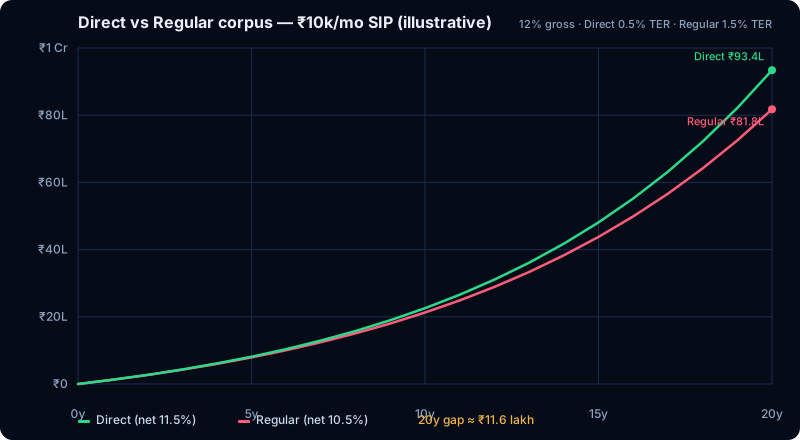
Figure: same assumptions as the table. Recompute with live scheme TERs using the [Direct vs Regular calculator](/calculators/direct-vs-regular-calculator). TERs above are placeholders for teaching — confirm current plan expense ratios on AMC / registrar disclosures.
How to read the gap without over-claiming
- Real TERs differ by scheme, AUM slab and plan; they change over time.
- Gross returns are not guaranteed; 12% is a modelling input, not a promise.
- Taxes, exit loads and behaviour (pausing SIPs, panic selling) are not in the table.
- Service quality and discipline can matter as much as a few basis points of TER for some investors.
Decision framework (four questions)
- Do I understand the scheme? Objective, Riskometer, factsheet, SID — before Direct vs Regular.
- Who helps me select and review? Independent, distributor-assisted, or separately engaged professional.
- What costs and services am I actually getting? Compare this scheme’s plan disclosures — not a generic “Direct saves 1%” meme.
- Can I stay disciplined? Plan choice cannot fix a goal / risk / liquidity mismatch.
Avoid these assumptions
- “Direct always means better.” Lower expenses help if you (or paid help) can research and monitor well.
- “Regular means a different fund manager.” For the same scheme, portfolio and manager can be common — verify documents.
- “Switching plans is only paperwork.” Tax, exit-load and process implications depend on scheme and your situation — get professional help where needed.
- “TER is the only metric.” Objective, risk, liquidity, service and behaviour still matter.
FAQ
Why can Direct and Regular NAVs differ if the portfolio is the same?
Ongoing expenses can differ. Over long periods that shows up in NAV and return experience. Cost is one input, not proof that one plan is “always right” for every investor.
In the ₹10k SIP example, how big is the 10-year and 20-year gap?
Under the illustrative 12% gross / 0.5% vs 1.5% TER assumptions: about ₹1.29 lakh at 10 years and about ₹11.6 lakh at 20 years. These are teaching numbers, not live fund quotes.
Is Direct safer than Regular?
No. Safety / volatility is mainly a scheme property (see Riskometer). Direct vs Regular is primarily cost and service route.
Where do I check real TERs?
On the scheme’s official expense disclosures (AMC / registrar / factsheet) — never treat a blog table as a live quote. Then stress-test your own SIP with the Direct vs Regular calculator or SIP calculator.
Related Findost guides & tools
- Direct vs Regular calculator — interactive TER gap maths
- Direct vs Regular guide
- SIP calculator
- Lumpsum calculator
- Mutual fund Riskometer before SIP
- Mutual fund portfolio review
- Fund overlap · Rebalancing
- FAQ · Ask PaisaGuru
Sources
Risk disclaimer (YMYL): Educational content from PaisaGuru by Findost / Findost (findost.io) — not personalised investment advice, a recommendation, or a solicitation. Findost is not affiliated with Findoc or FinDost. Tables and chart use illustrative TER and return assumptions — not current live fund quotes. Mutual fund investments are subject to market risks; read all scheme-related documents carefully and confirm plan expense ratios on official disclosures before acting.
Educational content from PaisaGuru by Findost — not investment advice or a solicitation. Findost (findost.io) is not affiliated with Findoc or FinDost. Investments are subject to market risks. Questions? Ask PaisaGuru or WhatsApp +91 62052 47092.